
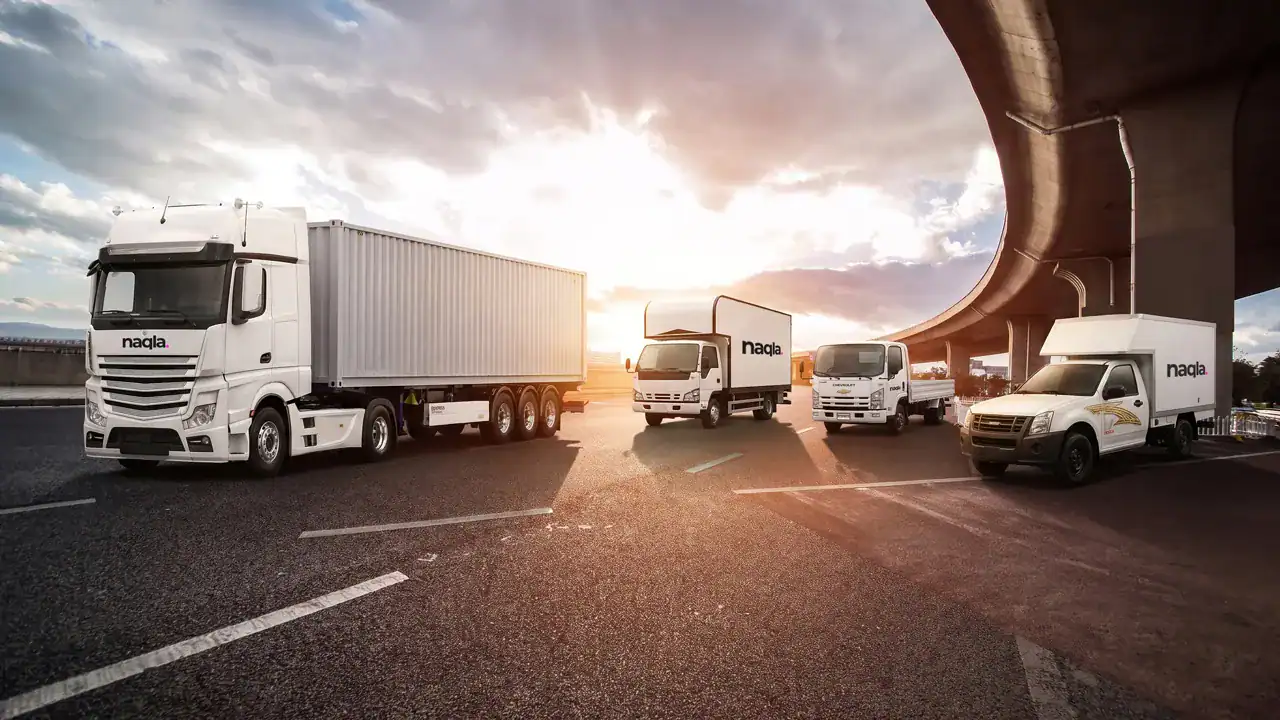
Choosing the right cargo truck is one of the most important decisions in any transportation operation.
In Egypt, businesses have a range of truck configurations to choose from: box trucks, six-wheel trucks, trailers, flatbeds, and container trucks all serve different needs depending on what’s being moved and where it’s going.
For businesses that are moving cargo on a regular basis, technology takes a lot of the guesswork out of the process. Naqla’s trucking platform connects businesses with a diverse network of carriers and truck types while keeping everything trackable in real time and backed by technology-driven logistics management that doesn’t require constant manual oversight.
Types of Cargo Trucks in Egypt
The right cargo transport truck depends largely on what you’re moving, how much it weighs, how much space it requires, and where it needs to go. Below are some of the most common truck types used for cargo transportation.
Trailer Trucks: The Best Choice for Long Distances and Heavy Loads
When the cargo is heavy, the volume is large, and the route is long, trailer trucks are what the job calls for; they’re built around exactly those conditions and are a staple of major commercial transport for that reason.
They are commonly used for:
- Large quantities of commercial goods
- Industrial materials
- Heavy equipment
- Construction materials
- Large-scale distribution
Trailer configurations aren’t one-size-fits-all dimensions and permitted loads can vary significantly between setups, which is why cargo always needs to be matched against the specific trailer’s specifications and what the legal limits actually allow before anything gets loaded.
When large quantities of cargo need to move across Egypt, trailers offer a practical way to load up capacity and cut down on the number of trips it takes to get the job done.
Six-Wheel Trucks: A Practical Choice for City and Intercity Transport
Six-wheel trucks hit a practical middle ground between capacity and maneuverability, which is exactly what makes them a solid fit across a wide range of domestic transportation requirements.
They can be used for:
- Commercial goods
- Manufacturing products
- Construction materials
- Distribution Transports
- Intercity transportation
That flexibility is exactly why so many businesses reach for them first, a cargo transport truck that can handle urban deliveries and intercity routes without feeling like a compromise in either setting.
Lorry Trucks: A Versatile Option for Medium Loads
Lorry trucks are commonly used for general cargo and medium-sized loads.
They are particularly useful when the transport does not require the capacity of a full trailer but still needs a dedicated commercial transport vehicle.
Depending on configuration, lorries can carry packaged products, industrial goods, construction materials, and other general cargo.
Jumbo Trucks: For Medium Loads and Diverse Transportation Needs
For medium-sized loads, jumbo trucks tend to be a reliable go-to — and with different configurations available, they can be matched to the type of cargo, its size, and whatever the transportation operation specifically calls for.
One of those configurations is the jumbo box truck — an enclosed loading area that keeps cargo shielded from outside conditions while it’s on the move. Box jumbos come in different sizes, with 4-meter and 6-meter options available depending on what the load requires.
Jumbo trucks can be used to transport a wide range of cargo, including:
- Packaged products.
- Retail goods.
- Consumer products.
- Electrical appliances.
- General commercial cargo.
The right jumbo configuration really comes down to what the cargo needs — its weight, dimensions, how it needs to be loaded, and how much protection it requires on the road.
Naqla gives businesses access to a broad mix of truck types and sizes, so finding the right fit for each transportation job doesn’t have to be a guessing game.
Refrigerated Trucks: For Food and Temperature-Sensitive Products
Temperature-sensitive cargo doesn’t get a second chance if the cold chain breaks, refrigerated trucks are built specifically to maintain the required temperature range throughout the entire journey, regardless of what the weather is doing outside.
They can be used for products such as:
- Certain food products
- Pharmaceuticals
- Temperature-sensitive materials
- Selected chemical products
Refrigerated transportation isn’t something to assume is covered. It’s a specialized requirement, and businesses should nail down the required temperature range, what monitoring capabilities are in place, and whether the right refrigerated equipment is actually available before any booking gets confirmed.
Tanker Trucks: For Liquids and Chemical Materials
Tanker trucks are built for one job: moving liquid cargo safely from one point to another.
Depending on the tank configuration and applicable regulations, they may be used for:
- Industrial liquids
- Fuel
- Certain chemicals
- Other bulk liquid materials
Because tanker transportation involves specialized safety requirements, the type of liquid being transported must be confirmed before selecting the vehicle.
Flatbed Trucks: For Heavy Equipment, Containers, and Steel
Flatbed trucks have an open platform instead of an enclosed cargo box, making them suitable for large or irregularly shaped cargo that may be difficult to load into an enclosed truck.
Typical applications include:
- Steel
- Construction equipment
- Machinery
- Large industrial components
- Certain containers
- Oversized materials
The open design makes loading and unloading easier, but cargo must be properly secured and transported within applicable weight and dimension requirements.
Container Trucks: For Transport To and From Egyptian Ports
Container trucks are designed to transport containers between ports, warehouses, factories, distribution centers, and other destinations.
They are particularly important for import and export operations involving Egyptian ports.
Naqla provides port transportation for cargo to and from ports, as well as cross-border transportation through its interconnected carrier network.
Dababa Trucks: A Practical Choice for Light Cargo and Urban Distribution
Dababa trucks are a common sight in light cargo transportation and distribution — particularly when the load doesn’t justify bringing in something bigger. Their size and ability to move easily through tight spaces make them a practical everyday option for getting things where they need to go within cities.
They can be used to transport:
- Light commercial goods.
- Packaged products.
- Supplies for shops and warehouses.
- Distribution orders.
- Small and medium-sized shipments.
Dababa trucks are particularly suitable for short-distance trips and urban distribution, where maneuverability and accessibility are important alongside cargo capacity.
How to Choose the Right Truck for Your Cargo: 3 Questions That Determine Everything
Choosing the right truck should start with the cargo itself, not the vehicle.
Three questions can help narrow down the most suitable option.
Question 1: What Are the Weight and Dimensions of Your Cargo?
Start by determining:
- Total cargo weight
- Length
- Width
- Height
- Number of packages
- Total volume
- Loading requirements
Cargo weight must remain within the vehicle’s permitted capacity. In Egypt, transport regulations specify limits for vehicle dimensions and axle loads, and the Ministry of Interior states that a transport vehicle’s dimensions should not exceed the applicable limits unless an authorized permit applies.
The key point is simple: don’t choose a truck based only on how much cargo you have. Consider both cargo capacity and physical dimensions.
Question 2: Does Your Cargo Require Refrigeration or Special Protection?
Some cargo needs more than space.
Ask whether the Transport requires:
- Temperature control
- Weather protection
- Enclosed storage
- Special loading equipment
- Additional cargo securing
- Protection from contamination or exposure
Packaged consumer products may be better suited to a box truck, while steel or large machinery may require a flatbed.
If the cargo is temperature-sensitive, a refrigerated truck may be necessary.
Question 3: Is the Transportation Route Within the City, Between Governorates, or To and From a Port?
The route matters almost as much as the cargo.
For urban deliveries where navigating tight streets matters, a smaller truck often makes more practical sense, while trailers come into their own on long-distance, high-volume runs where capacity is the priority.
Port operations are a different situation altogether. Container trucks are built specifically for moving containers between ports and inland destinations in a way that general freight vehicles aren’t set up to handle.
Egyptian regulations don’t treat all transport vehicles the same. Requirements shift depending on the vehicle’s configuration and the route it’s running, with trailers and semi-trailers facing their own set of rules around dimensions and speed limits that can’t be ignored when planning a transport.
Comprehensive Comparison of Cargo Truck Types in Egypt
The figures below are typical planning ranges rather than universal legal capacities. Actual payload depends on the specific vehicle, configuration, axle arrangement, road regulations, and cargo dimensions.
| Truck Type | Ideal Distance | Best Use |
| Trailer Truck | Long distance | Heavy and high-volume cargo |
| Six-Wheel Truck | City & intercity | General commercial cargo |
| Dababa Truck | Short to medium distance | Light cargo and urban distribution |
| Lorry Truck | Short to medium distance | Medium general loads |
| Box Truck | City & intercity | Packaged and protected goods |
| Refrigerated Truck | Short to long distance | Temperature-sensitive cargo |
| Tanker Truck | Medium to long distance | Liquids and bulk materials |
| Flatbed Truck | Medium to long distance | Steel, machinery, oversized cargo |
| Container Truck | Port & intercity | Transport containers |
Actual container payload depends on the container, truck/trailer configuration, axle limits, and applicable road regulations.
Egyptian traffic regulations define specific dimensional and axle-load requirements rather than applying one universal payload number to every truck.
Common Types of Cargo and the Most Suitable Trucks in Egypt
Different industries have different transportation requirements. The cargo itself usually determines which truck configuration makes the most sense.
Construction Materials, Steel, and Cement
Not all construction materials move the same way. Weight, size, and handling needs can vary widely from one load to the next.
Steel, heavy machinery, and large construction components usually call for flatbed trucks or heavy trailers, while packaged materials are often a better fit for enclosed or box trucks.
For heavier materials, payload limits and axle distribution are particularly important.
Food and Beverages
Food and beverage Transports may require enclosed transportation to protect products from external conditions.
Depending on the product, route, and temperature requirements, businesses may use box trucks or refrigerated trucks.
For temperature-sensitive products, refrigeration should be confirmed as part of the transportation requirement before booking.
Electrical Appliances and Electronics
Electrical appliances and electronics generally benefit from enclosed transportation that protects them from weather exposure and helps keep the cargo organized during delivery.
For packaged transports that need a bit more protection on the road, box trucks can be a solid practical choice.
Commercial Goods for Retail Distribution
Retail distribution often involves multiple transports moving between warehouses, distribution centers, and stores.
Depending on how much is being shipped, the route involved, and what the delivery actually requires, box trucks and other properly sized commercial vehicles can be a genuinely efficient way to get the job done.
Naqla’s domestic trucking service gives businesses access to a range of truck sizes and types. Box trucks for smaller loads when that’s what the transport calls for, and trailers when the scale of transportation demands something bigger.
Import and Export Cargo Moving Through Egyptian Ports
Cargo moving through Egyptian ports often requires container transportation between the port and inland destinations.
Container trucks are designed specifically for this purpose, while the appropriate vehicle depends on the container configuration, cargo weight, destination, and applicable road requirements.
FAQs
How do I choose the right truck based on the size of the goods?
The starting point is always the basics. Cargo weight, dimensions, and total volume. From there, think about how the goods need to be loaded, whether they need any protection along the way, and what the route actually looks like.
The truck should have sufficient cargo capacity without exceeding applicable weight or dimension limits.
What type of truck is suitable for transporting oversized or irregularly shaped goods?
Flatbed trucks are often suitable for large, heavy, or irregularly shaped cargo because their open platform makes loading easier.
Oversized cargo is a different matter entirely. Dimensions, weight, route, securing requirements, and any permits or restrictions all need to be carefully worked through before anything moves.
Do I need a refrigerated truck to transport food products?
Dry and shelf-stable products can usually make the journey without refrigeration, but anything that needs to stay within a specific temperature range will generally need a refrigerated vehicle to get there safely.
Before settling on a truck, always check the product’s temperature requirements first.
Conclusion
Choosing the right cargo truck is about matching the vehicle to the transport, not simply choosing the largest truck available.
Rather than going through the manual back-and-forth of calling different providers and checking availability one by one, businesses can use Naqla platform to get better visibility, simplify how bookings get made, and make logistics decisions based on real information.
At the end of the day, the right truck is the one that fits the cargo, suits the route, meets the capacity requirements, and keeps the load protected, while giving you the visibility and reliability your supply chain depends on to keep moving.